


English > UOGCC Publications > Letter
Icon – the picture of Golgotha
Post date: 2010-01-13Autor:
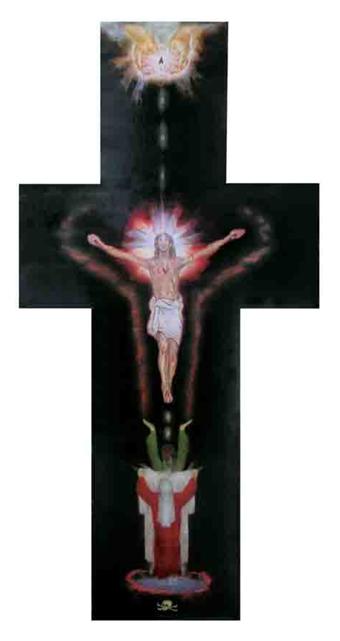
This picture – icon – expresses several deep mysteries with which every Christian is connected through faith and holy baptism.
The reality of sin
The wide black cross symbolizes sins as well as original sin in us – the old man – the corrupted human nature.
Sin brings death, both temporal and eternal. This is imaged by death’s head at the bottom of the black cross.
By His death Christ conquered death, sin and the devil.
The mystery of baptism
Jesus’ mother stands on a baptismal well and holds in her hands a white robe symbolizing a white wedding garment which is required for entering the wedding feast (see Mt 22:11). Baptismal water beneath the cross symbolizes that through baptism we were immersed in Christ’s death (see Rom 6:3) and then also our resurrection with Christ (see Col 2:12).
Crucifixion with Christ (cf. Gal 2:20; Rom 6:6)
The mystery of crucifixion of the old man with Christ is depicted in the icon by the silhouette around the cross. The old man has a spiritual substance and is like a dark cloud coming out of the hands of the disciple standing under the cross.
Likewise the words of the Scripture: “Put off the old man.” (cf. Eph 4:22; Col 3:9) express the reality of crucifixion with Christ. Crucifixion with Christ is identical with true discipleship. Through a deed of faith the disciple unites with Jesus and time and again puts off the old man (cf. 2Cor 4:10), and this is so-called “walking in faith”. We all inherited the spiritual root of darkness from the first woman Eve. Eve by her disobedience opened our nature for the slavery to the spirit of lie and for the rule of darkness.
Christ’s testament
God’s Word also says: “Put on the new man.” (cf. Eph 4:24; Col 3:10). Who is that new man created in true righteousness and holiness (see Eph 4:24)? Jesus is not created, He is begotten, He is true God. The new man is the person closest to Christ, the person full of grace (cf. Lk 1:28), and that is His Mother. She is the new Eve who, unlike the first Eve, stood the test of obedience. She believed God and therefore she is blessed (cf. Lk 1:45), therefore all generations will call her blessed (cf. Lk 1:48). Mary is not only the new Eve but also the new spiritual centre – the new heart which is without sin. Through the merits of Jesus she was preserved from original sin and granted an extraordinary task in the Church – to be the mother of the Word, Theotokos – the Birthgiver of God (on 7th June 431 in Ephesus the Church explicitly and obligatorily proclaimed an article of faith referring to Jesus’ mother but to Jesus as well).
God gives a promise through the prophet Ezekiel: “I will give you a new heart...” (Ezek 36:26) In the last hour Jesus sees His mother and He also sees His disciple. He gives His mother to the disciple and to all disciples. In that hour and in that moment the Heavenly Father performs a spiritual transplantation of heart. This mystery is expressed in Jesus’ word: “Behold, your mother.” (Jn 19:26) “After this, Jesus knew that all things were now accomplished, that the Scripture might be fulfilled...” (Jn 19:28) The accomplishment was in the fact that “the disciple received her into himself (Gr. eis ta idia, Lat. in sua)”. How could the disciple receive Jesus’ mother into himself? The answer is given by St. Ambrose: “He received her soul to magnify the Lord in him and received her spirit to rejoice in God.” These disciples with the new heart are the new generation of prophets. The Holy Spirit works through prophets. Jesus’ mother is full of the Holy Spirit (cf. Lk 1:38). When she greeted Elizabeth, all the house was filled with the Holy Spirit. All: Elizabeth, Zacharias and also John in the womb of Elizabeth became prophets. The disciple and apostle that received her under the cross likewise became a prophet. This is testified not only by his Gospel but also by his epistles and particularly by his last and the only prophetical book of the New Testament of which he is the human author.
In the icon the mother of Jesus gives the disciple a new pure white robe symbolizing the fullness of grace which she is encompassed – clothed with (Kecharitomene, cf. Lk 1:48). Her red robe expresses that she received the fullness of God’s life. “As many as received Him, to them He gave the right to become children of God.” (Jn 1:12). She was the first to receive the Holy Spirit in fullness and through her obedience of faith the Word became flesh (Jn 1:14). In this we are to follow her as our mother, that in us too the living Jesus may be conceived and live. (Mary + Holy Spirit = living Jesus).
Christ’s death
Jesus’ death means breaking of the power of sin, overcoming the devil, the culminant moment of love to the Father and to the immortal souls. Through baptism we take part in this mystery. In the moment of death, Jesus commits His spirit into the arms of the Father. This is depicted in the icon by a cloud of light around Jesus’ head where Jesus’ spirit is concentrated in the very last moments of His earthly life. The moment of death – last breath – amidst the darkness is concentrated in the word Abba (Father). The letters are divided here as a way leading to the Father’s arms. The arms of God above the black cross are shone through with light. The commitment of spirit in the moment of death Jesus expresses with the cry: “Father, into Your hands I commit My spirit.” (Lk 23:46). God’s Word reminds us: “Or do you not know that as many of us as were baptized into Christ Jesus were baptized into His death?” (Rom 6:3) Through crucifixion with Christ the disciple puts off the old man and puts on the new one – the new nature. The disciple’s unity with the dying Redeemer and with His death is rendered in the icon by separation of letters which like little cloudlets above the head of the disciple depict the moment of unity with Christ’s death. This is the narrow way: Jesus’ death, through which one enters eternal life.
The name Jehoshua – Jesus
Calling with faith on the name of Jesus – Hebrew Jehoshua – particularly in the hour of one’s death, leads to the victory over demonic powers and to salvation. The mystery of God’s name is contained in the name Jehoshua – the Lord (Yahweh) is my salvation. Those who received Jesus became children of God and only these God’s children can call God in truth: Abba, Father. This was also the last Jesus’ word in the moment of His death. The “spiritual way” to unity and communion is depicted in the icon by the letter “a”. If we are to call – cry, it is helpful to use this vowel “a” (prolonged “aa”) which is contained in the name Jehoshu-aaaa as well as in the name Abb-aaaa! “We who live are always delivered to death for Jesus’ sake.” (2Cor 4:10f) What does it mean? It means that we wholly commit ourselves to the will of God and that we wholly die to our will, fear or to our desires. At the same time this all is connected with faith which unites us with Christ’s death, when our spirit along with Jesus’ spirit we commit into the arms of the Father. This act of faith we will need to make especially in the moment of our physical death. This is why every day at three o’clock we make a stop for one minute and call on the name of Jesus. At this hour we realize the moment of Christ’s well as of our death in unity with Him. (Repeat: “Jesus, Jesus, Jesus, have mercy on me sinful” – this is repeated five times to worship the five wounds of Christ.)
(This icon – the picture of Golgotha – is the fruit of prayers of the sisters of the contemplative Monastery of St. Elijah the Prophet in Bryukhovychi near Lvov.)
Added files

|
Download Icon – the picture of Golgotha .DOC 70.0 kB |