


English > UOGCC Publications > Letter
The original sin and the deliverance
Post date: 2006-05-24Autor:
The Original Sin (in Adam) and the Deliverance (in Christ)
Letter to Cardinals and Bishops of the Catholic Church
The mystery of the original sin can be understood only within the relation to Christ’s death and resurrection (Catechism of the Catholic Church 388). The Word of God points at two opposite polarities – Adam and Christ. He who abides in Adam is in death and in slavery. He who enters into Christ’s death has a new life and a true freedom.
The Holy Father Benedict XVI. (Cardinal J. Ratzinger) says: “The inadequacy to comprehend the original sin as well as the inadequacy to explain it to believers is indeed one of the most relevant issues of the contemporary theology and pastoral service.”
Upon the issue of the theology of liberation and true freedom he says: “Yet the danger of certain theologies is that they let one force upon them an immanent, pure earthly position of liberation programmes. From the Christian point of view ‘liberation’ first of all is deliverance from the slavery of sin, and that is in Christ…”
The life of God in Christ (picture 1)
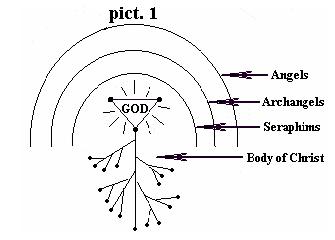 We were born as children of Adam without the life of God. If we are not born again and continue in this state of spiritual death, we will be condemned for ever. Jesus said: “You must be born again. That which is born of the flesh is flesh, and that which is born of the Spirit is spirit.” (Jn 3:6f) How are we to be born again? This means that we receive the Lord Jesus into our life through faith! “To all who received Him He gave power to become children of God.” (Jn 1:12) “God has given us eternal life, and this life is in His Son. He who has the Son has life; he who does not have the Son of God does not have life.” (1Jn 5:11-12) Do you now have eternal life? If you have the Son, then you also have His life and His righteousness.
God created angels, archangels, seraphims… (see the picture). The life of these spiritual beings is in nearness to God. But we have been granted a greater dignity. In Christ we have life directly in God!! St. Augustine supposes this to be a work much greater than the creation of heaven and earth, beacuse heaven and earth will pass away but eternal life will never end (cf. CCC 1994).
Through cross and death towards freedom
Adam acted on his own, separately from God. In this fact is contained the whole tragedy of the Paradise. Jesus, on the contrary, in everything acted in dependence upon God. His programme was: “Father, not my will, but Yours, be done.” (Lk 22:42)
We can say that every work of Jesus done on this earth was based on the principle of death and resurrection, though the work of Golgotha was to be truly accomplished not until the end of His life. God distinguishes only those as His servants who have gone through death to the basis of resurrection.
In Mk 8:35 the Lord Jesus speaks about the mental activity of man and about the necessity of losing one’s soul for His sake and the Gospel’s. In soul there is a seat of our relations (to our self, to people, to things…). Many times the very thing that we are to lose – and at that moment even our soul together with it – is not some sin but the matter here is a hidden love which through the natural inclination changes our right direction. Indeed, human inclination plays an important part in our life, that is why the cross has to come and do purificatory work. A single look back can often decide everything. Man loses sight of eternal values and of the light of God, fixes his eyes on vanities and in false light loses the kingdom of God.
Why is the life of God so little manifested in us? Why is this God’s life so little visible? The reason is that we still live in our soul (in our will, in our reason…), that we work and serve in our own might. We do not draw power from God. An independent soul stands in the way of the new life; therefore we have to lose it for the sake of the Lord Jesus.
Dependence upon God: “For we who live are always delivered to death for Jesus’ sake, that the life of Jesus also may be manifested in our mortal flesh.” (2Cor 4:11) What does it mean? It simply means that we are not going to do anything without reliance on God. I will not be relying on myself. By eating the forbidden fruit Adam appropriated the interior power of acting and deciding, but this was power independent of God. In this power he was fulfilling not the will of God but the will of satan. That is why we cannot act in accordance with our own initiative. We must live His life and from Him we must receive everything. This is the life in the second Adam – in Christ!
Juridical person: The Catechism puts a question: How did the sin of Adam become the sin of all his descendants? (CCC 404) So that they already came out of a spiritually dead Adam. The one who is dead is no more able to transmit life. He only transmits what he has got himself – the spiritual death. His descendants are born the same as him – spiritually dead. All that we need to do is to be separate from Adam and enter into Christ. He will then become our life. In a sense God views Christ in the same way as He views Adam. God regards Adam and everyone who comes of him as a single man. In the same way He regards even Christ as the head and everyone who comes of Him He encompasses in a single new man that lives His life. It is something like the juridical term “juridical person”. The component part of this unifying person is represented by every one of us who have received Jesus as our Saviour and Lord. Whatever is done by the juridical person relates to everyone.
Two questions and answers on Rom 5:12:
1) Which two negative realities entered the world through one man? Sin, and death through sin.
2) To how many people did death spread and why? To all, because all sinned in him (except the Mother of God!).
If we abide in Adam, we are spiritually dead. If we abide in Christ, we have His life.
The sin, the old man and the body (pict. 2)
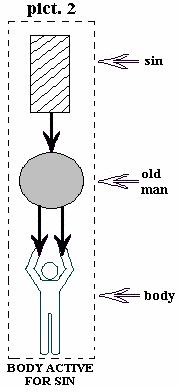 “We know that our old man was crucified with Him so that the body of sin might be destroyed, and we might no longer be enslaved to sin… Do not yield your members to sin as instruments of unrighteousness…” (Rom 6:6-13).
In this passage we have three important factors. The first one is the sin, the second one is the old man and the third one is the body. By the term “body” one does not mean only our biological body with its members and five senses, but one thereby also means the potencies of our soul, such as the mind and the will.
The sin is personified by a ruler who chains and forces man to commit all particular sins. Man then becomes a slave of sin, is submitted to this tyrant nad fulfils all his commands.
The old man mentioned in the Bible is our nature in Adam. Deep in a man there is love for sin. When a temtation appears, one is rejoiced by hearing its challenge and happily submits to its power. Sin is a powerful factor, and if on top of that it meets with the old man in a concrete situation, the outcome is an immediate cooperation.
In this arrangement these two seek some instrument and find the body. Mental potentialities of the body engage the members. They either bring eyes to look, ears to listen or hands to move. In this way the body fulfils orders dictated by the sin and supported by the old man. The sin is the boss, the old man submits to its commands and the body fulfils them in practice in the form of trespasses. These three make unity. They agree with one another. The result of their cooperation is a number of sins that we commit.
Crucifixion with Christ, death (pict. 3)
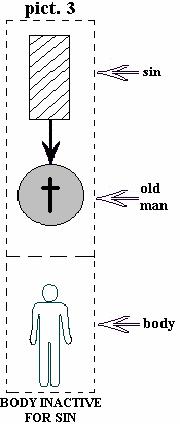 “Adam became a living soul” (1Cor 15:45). Through the sin he lost the relation with God and he was left only with mental (psychical) life which through sin is joined to satan. He became independent of God and thus similar to the devil.
Independent development of mental life turns away from God and leads to self-divinization (“You shall be as God, as gods” Gen 3:5). The way out is the death of Christ: “We were buried with Him through baptism into death.” (Rom 6:4) Walking in faith means actualizing our baptism! If I unite with the power of Christ’s death by faith, here the sin and the devil are overcome and the same is done with the old man.
How is it with the body? The old man is crucified and immersed in Christ’s death, therefore the power of sin cannot keep the body under control. The body no longer listens to the sin, nor does it agree with its proposals. Under these conditions the body has nothing more to do, it stops being employed. My mouth was constantly criticizing before, now it is no longer working in this way; it has lost its job. My feet that used to walk in their own ways now walk in them no longer; they have likewise got unemployed. My eyes, ears and even my whole body have become unemployed (katargethé) in relation to the sin.
The Holy Spirit, the new man and the body (pict. 4)
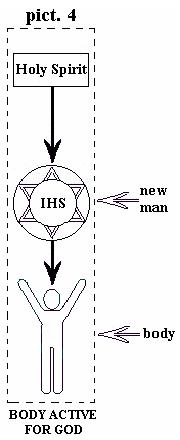 What does it mean to have part in the resurrection of Christ? The Holy Spirit renews in the baptized soul the power of the new life. Afterwards the body, that is the mind and the will, and the members of the body become bearers of this life.
“That He would grant you to be strengthened with might through His Spirit in the inner (new) man, and that Christ may dwell in your hearts through faith.” (Eph 3:16)
In this passage again we have three important factors. The first one is the Holy Spirit, the second one is the new man and the third one is the body (the heart). In place of the sin, which was personified as slave-holder and tyrant, the rule is taken up by the Holy Spirit.
The new man which is spoken about in the Bible is our new nature which we reсeived when we were born anew (Jn 3:7).
When through an act of faith and act of love the old man (Adam) is in a concrete situation immersed in Christ’s death, it means that at this moment the new man, which was paralysed by the sin and by the old man, is activated (resurrected). The reactions of the new man are much different from the reactions of the old man. He no longer listens to the enticement of the sin, never provokes the body to commit evil. The new man stands up against the sin as radically as possible, he is deaf to his proposals. So this is in the first place not the question of a head-on fight with the sin, nor of an outward mortification of the body, but this is the question of a change of the substance through faith. In this new arrangement the Holy Spirit and the new man likewise seek some instrument and they find it in the body. In this way the body fulfils the orders inspired by the Spirit and accepted by the new man. The Holy Spirit has now taken up the rule in place of the sin (which acted as the boss). The new man now submits to the orders of the Spirit and the body fulfils them in practice in the form of doing the will of God. These three make unity, agree with one another and the result of their cooperation is the fruit of the Spirit (see Gal 5:22).
The new life is not working (pict. 5)
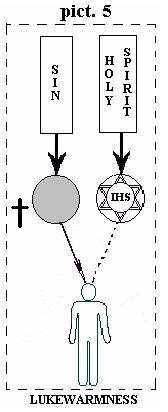 It is not enough that we were baptized, that we turned away from the world, that we received Christ as our Lord and it is not enough that we received in fullness the same Spirit as the apostles. We also have to live according to the Spirit and this is a fight! “We are not contending against flesh and blood, but against principalities, against powers, against the rulers of the darkness of this age.” (Eph 6:12)
Living the new life is conditioned by “walking in faith” (Rom 6:11). As soon as I stop watching (cf. Mt 26:41), the old man automatically comes down from the cross, “revives”, and paralyzes the new life, takes up the rule and again makes the body turn into an instrument of the sin (cf. Rom 7:5).
That is why again and again through an act of repentance and faith we have to enter the death of Christ (cf. 2Cor 4:10f), otherwise the old man will breed jealousy, pride, murders, adulteries etc.
Christ paid for our sins with His blood on the cross. There on the cross the old man (Adam) was also crucified together with Him. Christ became the satisfaction for our sins as well as for our nature of Adam. On that day it was not only our sins that were on the cross but our nature, too. When Christ was crucified, we were crucified, too. Provided that we understand this single point, the rest will be clear: “I have been crucified with Christ; it is no longer I who live, but Christ lives in me.” (Gal 2:20)
Walking in faith (pict. 6)
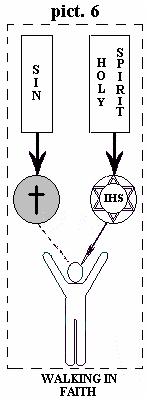 If the old man is not on the cross, Christ does not live in me (pict. 5). When the old man is in a concrete situation on the cross and immersed in death with Christ (pict. 6), the sin does not take any effect on the body and “Christ lives in me”. This is walking in the Spirit, the life of victory, the life of freedom! This is what we need to learn and live first of all in an interior prayer. “Could you not watch with Me at least one hour (daily)?” (Mt 26:40) (see Four Words from Ukraine – see contemplative prayer, www.community.org.ua).
“He who is joined to the Lord is one spirit with Him. Or do you not know that your body is the temple of the Holy Spirit who is in you? You are not your own; therefore glorify God in your body and in your spirit.” (1Cor 6:17f)
The example to us of the life in Christ is Paul the Apostle: “In all things we commend ourselves as ministers of God: in much patience, in tribulations, in needs, in distresses, in stripes, in imprisonments, in tumults, in labours, in sleeplessness, in fastings; by purity, by knowledge, by longsuffering, by kindness, by the Holy Spirit, by sincere love, by the word of truth, by the power of God, by the armour of righteousness on the right hand and on the left, by honour and dishonour, by evil report and good report; as deceivers, and yet true; as unknown, and yet well known; as dying, and behold we live; as chastened, and yet not killed; as sorrowful, yet always rejoicing; as poor, yet making many rich; as having nothing, and yet possessing all things.” (2Cor 6:4-10)
“To renew everything in Christ” (St. Pius X.)
The source of our faith is Christ. Unless we have a relation to Christ created, we have no power. It makes no sense just to deduce and discuss things superficially.
We are embodied in Christ. When Christ died on the cross, we who are in Him died, too. With the condemnation of Christ we have been forgiven, with His death we have been delivered from the nature of Adam. On the one hand we receive forgiveness of sins and end of the old life, on the other hand we begin again to live the new life in Christ.
Consequently, the true Christianity invites us in the first place to enter into a relationship with Christ. Not until one enters into this relationship, one can start the way of following Christ and only then a living theology.
Conditions for entering the relationship with Christ – repentance:
1) It is necessary to break up with the teaching of R. Bultmann and his school.
2) It is necessary to break up with the false sympathy with pagan religions.
3) It is necessary to break up with all covert (occult) forms of magic, divination and spiritism.
4) It is necessary to break up with the views of teilhardism, modern psychologies and philosophies.
5) It is necessary to break up with the spirit of the world and spirit of the New Age.
6) It is necessary to receive Christ as one’s personal Saviour and Lord, and to receive the baptism of the Holy Spirit.
7) It is necessary to receive in one’s daily programme at least one hour of interior prayer.
Conclusion:
The mystery of the original sin can be understood only within the relation to Christ’s death and resurrection (CCC 388).
The Word of God points at two opposite polarities – Adam and Christ.
He who abides in Adam is in death and in slavery, he who enters into Christ’s death has the new life and the true freedom!
Elaborated by:
Fr. Eliáš A. Dohnal ThD. OSBM
Fr. Metod?j R. Špi?ík ThD. OSBM
Fr. Markian V. Hitiuk ThLic. OSBM
Fr. Cyril J. Špi?ík ThD. Ing. OSBM
Pidhirtsi 24th May 2006
The feast of St. Cyril and Methodius
Copy: the Holy Father Benedict XVI.
Added files

|
Download The original sin and the deliverance (24.5.2006) .DOC 518.5 kB |